What Do You See? (and What It Means for Your Creativity)
Take a look at the image below. What do you see?
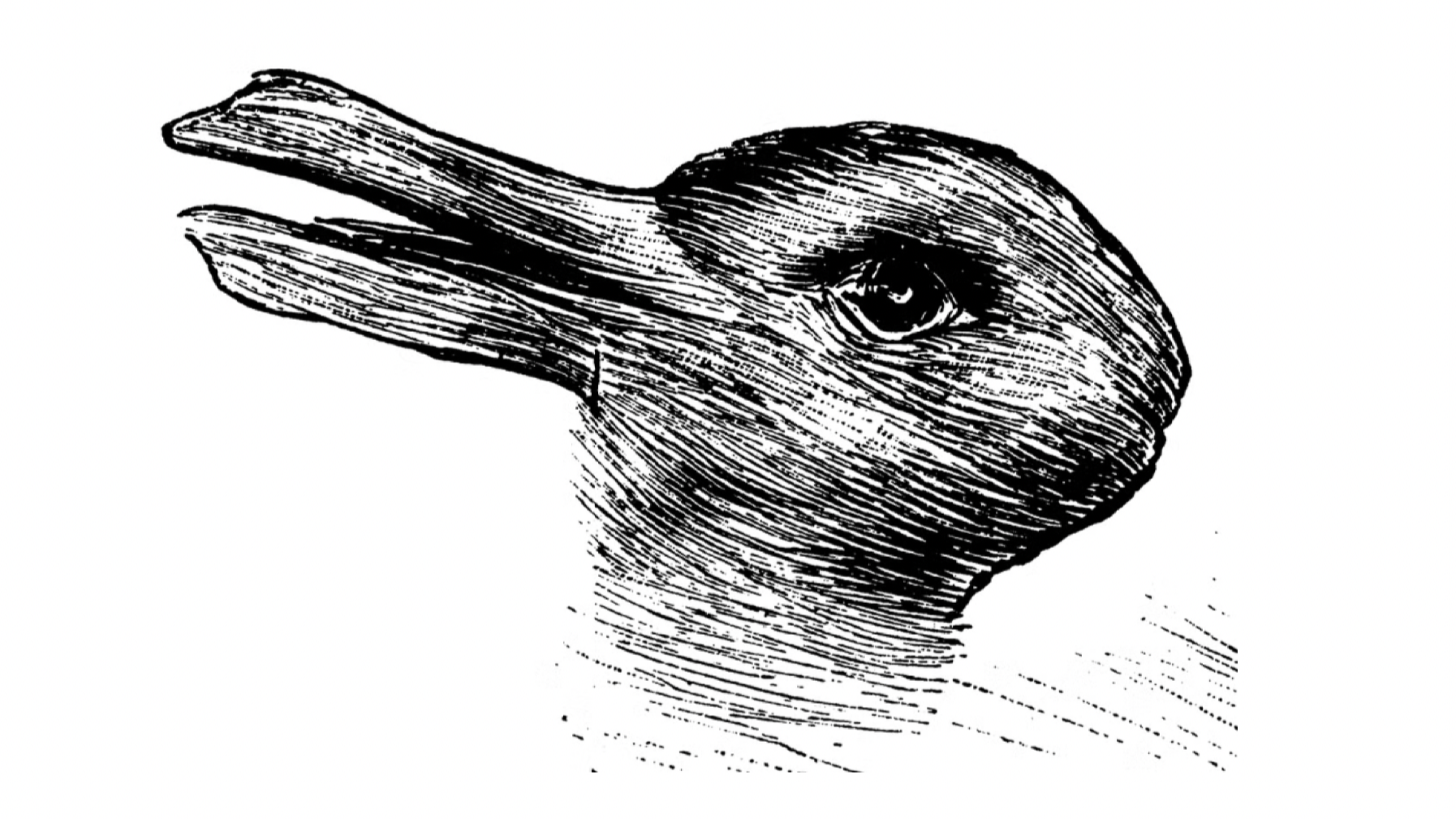
Some people see a bird. Others a rabbit. In reality it is, of course, just an arrangement of pixels on a screen, but your brain, which hates uncertainty, can’t help but configure the pixels into the likeness of a creature, based on the totality of your experiences up to this point. If you saw a bird, can you now see the rabbit? Or vice versa? And once you’ve seen both creatures are you able to easily flip between the two?*
The extent to which you can readily flip – bird / rabbit, rabbit / bird – is an indicator of your cognitive flexibility. And your cognitive flexibility is a very good indicator of your innate creativity; a better one in fact than more traditional measurements, like IQ.
So what is ‘cognitive flexibility’? Why does it matter when it comes to creativity? And if you’re struggling to see past the bird – or the rabbit – how can you enhance yours?
Well, in order to answer these questions we need to take a trip inside the 1.4kg lump of grey matter that’s lodged between your ears. Most people have heard of the left / right hemisphere model of the brain. For a long time it was thought that the right hemisphere was the zany, artistic half, tripping out in an endlessly evolving rainbow landscape, whereas the left hemisphere was the dull, beige accountant, reckoning and reasoning, yoked to the rigid frame of logic.
While there is a degree of truth in this model, and the brain is physically arranged in two halves, we now know that the picture is much more complex (as you might expect it to be given the 86 billion neurons). Thanks to ever more sophisticated brain imaging techniques, scientists are able to watch in real time what’s happening when you’re thinking, resting, arguing, making love, eating a banana or occupied with just about any other activity.
And most of the time what’s happening is that different networks of the brain are coming on or offline, often across hemispheres, according to the situation.
When it comes to creativity, which, for the purposes of this article, I’ll define as the act of bringing something of value into being that didn’t previously exist, there are three networks that are critical. The deeper your understanding of these, the more likely you are to be able to switch between them; and the more able you are to switch between them – as we’ve already established – the more creative you’ll become.
The first of these three networks is the executive network. Largely controlled by your dorsolateral prefrontal cortex, the executive network is responsible for planning, reasoning and analysis (perhaps because of its name I tend to think of it as wearing a suit and tie and carrying a briefcase). It’s the part of the brain you use when you sit down to try and solve a problem using logic. It’s good at maths, but not so good at blinding moments of insight. Interestingly, the prefrontal cortex is the last part of our brains to develop - not being fully formed until we’re in our twenties - and this is thought to account for the fearless, unbridled creativity we have as kids.
Let’s see how dominant your executive network is with this simple test …
I know, right? This test was repurposed in the UK in the noughties to encourage drivers to look out for cyclists, so older British readers might have already seen something similar, but, if you haven’t, the chances are you didn’t see the gorilla. Your executive network was on the case, doing its job, counting the passes and so you missed the most remarkable thing about the film.
Which brings me on to the second of the three networks we use in the creative process. And it’s the most important: the default mode network. For most of the modern era, the period in which we’ve been aware that the brain is the seat of our cognitive processes, we made an understandable but false assumption: it was believed that when we weren’t actively thinking our brains were at rest. Thanks to neuro-imaging we now know that this isn’t true. More than this, it’s spectacularly wrong. When we’re not consciously thinking, the default mode network kicks into gear. It’s active across several different regions of the brain and it’s more powerful than the executive network. It’s the home of our imagination. It’s active when we let our minds wander. And it’s the source of the very best insights and ideas.
Do you find that you tend to have your best ideas in the shower? Or when you’re walking the dog, or doing the dishes? Well, that’s because your executive network is switched off and your default mode network is coming into play. The latter has a higher processing power than the former. Great artists, scientists and innovators have always understood this, explicitly or intuitively.

The Last Supper by Leonardo Da Vinci (restored version)
Having been commissioned to paint the Last Supper by a wealthy Milanese duke, Leonardo Da Vinci was admonished by said duke for failing to paint anything. He’d arrive at the church refectory where the fresco was to be painted, gaze up at the blank wall and then wander dreamily around the nearby gardens. When the duke challenged him, Leonardo declared icily: ‘Those of lofty genius sometimes accomplish the most when they work the least.’
And it’s true. Almost all our great minds make time in their process for mind wandering. Einstein would play his violin. Margaret Atwood is an advocate of walking. Thomas Edison recognised that he had his best ideas when dropping off to sleep – when the executive network switches off, and the default mode network on – so he would take a nap in his study holding steel balls above a metal plate. The clatter would wake him up and allow him to capture his best ideas.
A problem with being a professional creative in 2026 is that the value of this critical part of the process is hard to quantify. Sitting at your desk, tapping away at your keyboard, logging on to another Zoom meeting, these things all make sense in the context of time-sheets, in a way that staring vacantly into space doesn’t. But without the space-staring – or equivalent – there’s simply no room for the creative gods to come along and share with you the inspiration you need for a great idea.
And finally there’s a third neural network with a role to play in your creative process, and that’s the salience network. There’s a clue in the name: the salience network is very helpful in identifying things that stand out. Like great insights, or ideas, or the kind of curious anomalies that could lead to a great insight or idea. Let’s try and engage yours – no tricks this time. I’d like you to spot the ‘O’ among the ‘Ds’ below …

There, that wasn’t too tricky, was it? (If you struggled, it’s in the fifth row, seven columns from the right – and you might need to get your salience network checked out).
The creative process is a complex one. It’s beyond the capabilities of a single neural network. You need the executive network to help you understand the problem you’re trying to solve, to decode the brief for example, and it’s helpful later on to help you think about how best to convince others of the value of your solution. Engaging your default mode network – by going for a walk, taking a shower or falling asleep clutching some metal balls – is vital if you’re to get beyond easy, conventional, run-of-the-mill ideas and into a space where the genuinely original concepts reside. And then you’re going to need your salience network to sort the wheat from the chaff, and identify which ideas really stand out.
So you need to be able to switch between all three networks, depending on where you are in the process. For some people, like our bird / rabbit switchers, those with the greatest cognitive flexibility, this comes easy. But for the rest of us, it’s harder. Perhaps you’re more of a mind wanderer than a logician. Or you’d rather hold on to what you know than allow yourself to let go and follow a flight of fancy. Either way, it doesn’t matter too much. The important thing is to recognise where your tendencies reside and then make a deliberate choice to engage a different network when you need it. To look for the rabbit when you see the bird, or the bird when you see the rabbit.
If you’d like to enhance your capacity for creative thinking, discover how creative coaching could help you by clicking the button below …
*Only 3 per cent of people see both a rabbit and a bird without prompting.