How a Harlem Hustler Took on High End Fashion - and Won
This is a story of creative ingenuity, and of how to bend when others might break. It’s also a tale of ghetto life, hustling, and some very, very fine clothes. And it begins in Harlem, New York in the 1940’s, when horse drawn buggies could still be seen trotting along the streets.
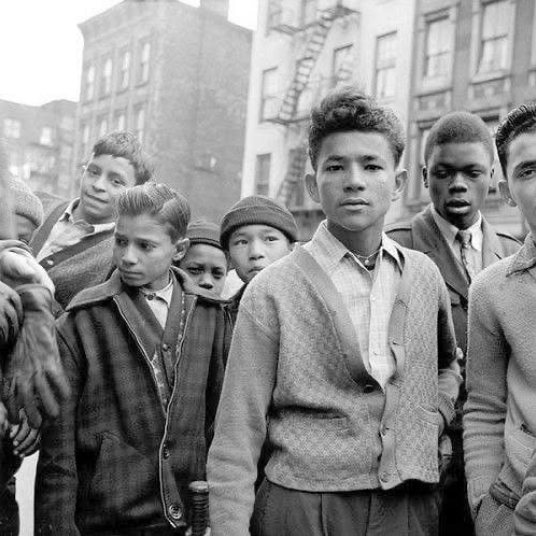
Boys in 1940’s Harlem
Daniel R. Day was born on August 8th, 1944. His grandmother delivered him and he lived with her, his parents and his six brothers and sisters in a small apartment a couple of blocks south of the Harlem river. Dan was a smart kid, creative too. His family had barely enough money to feed themselves, even less for toys, so he would occupy himself making sculptures from clay on the riverbank.
It didn’t take long though before Dan’s pastimes became a little less wholesome. First he learned how to steal copper wires, strip them down and then sell them in loads artificially weighted with lead. But soon he discovered there was a lot more money to be made as a gambler. At 13 he’d take himself off to the library to read books on probability, before putting the lessons he learned to practical use in dice games. His research - and a natural ability to read people - meant that in his teens he could sometimes bring home several hundred dollars a day.
By 20 Dan had started using heroin, and dealing a little on the side. He was caught and locked up. Had this happened in 2026 he might well have been looking at a sentence of several decades. As it was, he served just a month. But in those few weeks he began to read Malcolm X and Marcus Garvey, and, by the time he left jail, he decided that he’d become a writer and devote himself to Black consciousness.
Columbia University recognised his talent and sponsored him to tour Africa, in return for articles and essays along the way. He was given a commission to cover the legendary ‘Rumble in the Jungle’, the fight between Ali and Foreman in Zaire, but when the latter got injured, it was postponed. With time on his hands, Dan decided to head to Liberia. And there, in one of the many chance moments that would come to define his life, he befriended a tailor who used vivid local fabrics to make extraordinary clothes. Dan was mesmerised. He had a feeling that now, finally, he knew where his future lay.
Back in Harlem how you dressed mattered. From his time working the streets Dan had an intimate understanding both of ghetto style and how hustlers liked to look. He began by selling stolen designer clothing from the trunk of his car.
It worked. For a while. But the threat of being sent back to prison was never too far away, and after a couple of close calls, he decided to go legit and buy his garments wholesale. The problem was that almost all fashion wholesalers were white, and they were reluctant to deal with a Black man, especially one from Harlem.
As someone with the ability to see a door where others see a wall, Dan decided that if he couldn’t buy the clothes he wanted to sell, he would just have to make them himself. And so in 1982 Dapper Dan’s Boutique was born. Aiming for high-end customers, he sold furs to begin with – but soon discovered that no one buys fur in summer. Then, when the girlfriend of a local drug dealer came into the boutique with a Louis Vuitton purse, he noticed how people’s eyes were drawn to the interlocking L and V of the logo. So Dan went back to that same local library where he’d studied probability as a kid. Except this time he wasn’t interested in maths; now he wanted to learn everything he could about luxury branding.
The first piece of clothing that really got him noticed was a jacket adorned with Gucci logos. The logos came from canvas bags he’d bought at the Gucci store downtown. But the bags were expensive and his welcome through the doors of the luxury shop hadn’t exactly been a warm one, so he went back to Harlem and developed his own technique for printing logos onto fabric. And once he’d nailed that, things took off. Big time.
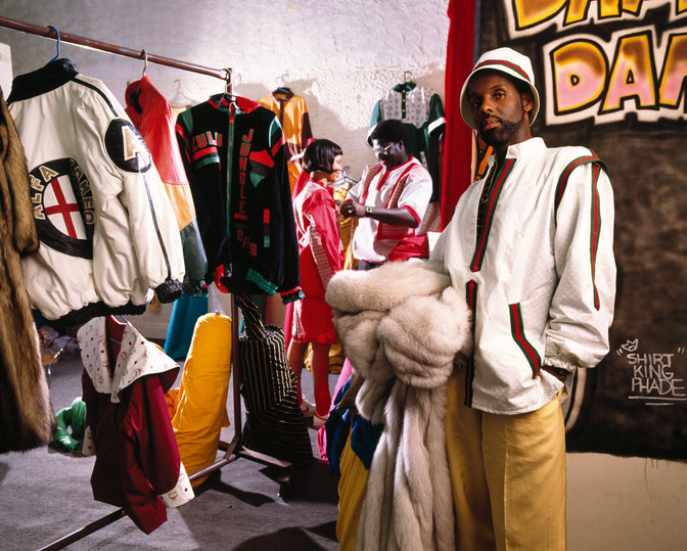
Dapper Dan at his shop on 125th Street in 1989
Dan called his creations ‘knock ups’ rather than ‘knock offs’. In his eyes he was putting the logos to way better use than the labels themselves. Back in the 80’s, the high-end fashion houses catered for a white elite; Harlem might as well have been another universe and they saw no market there. Except this was the era of hip hop - and crack cocaine. And not everyone in the ghetto was as impoverished as they’d once been. Well-heeled artists like Eric B. and Rakim, LL Cool J, Salt-N-Pepa, Slick Rick and Run DMC became regulars. As did gangsters like the notorious Alpo Martinez. So popular was Dapper Dan’s Boutique that it was open 24 / 7, catering for its clients unconventional waking hours, with Dan snatching a few hours’ sleep whenever he could in a box room round the back.
Dan made to order and turned things round fast. His process was driven both by his own creativity and the very specific requirements of his clientele. There were requests for bullet-proof parkas. And hidden pockets to conceal … well, anything that might need concealing. This was high-end clothing for the hood. Inventive, eye catching, made to measure, and almost always badged with reworked Fendi, Gucci, MCM or Louis Vuitton logos. For Dan, life and business were good.
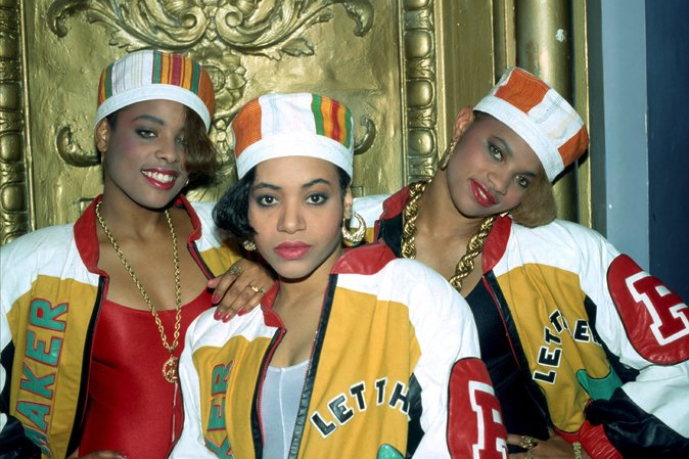
Salt-N-Pepa, including DJ Spinderella, in Dapper Dan’s designs in 1988
But then in 1988 Mike Tyson, wearing a ‘knock-up’ jacket he’d just bought from Dan, got into a fight with fellow boxer Mitch Green outside the store and Dapper Dan’s hit the headlines. People outside Harlem started taking notice – including, somewhat unfortunately for Dan, the copyright holders of the logos he’d been using.
It wasn’t long before lawsuits, police raids and the weight of the white establishment began to bear down on his business and in 1992 Dapper Dan had to close his store.
Dan published his memoir in 2019 and there have been rumours of a biopic for the past few years, but few people outside the world of fashion, and outside the US, know his story. And it’s one that holds lessons for creatives of all kinds …
The first is to work with what you have. That’s true not just of the clay Dan used to play with on the banks of the Harlem river, but it’s also true of the way he used the insights gained through hustling on street corners to understand human nature. He knew just how powerful desire and status are, and how to cater for them in a way no one else was.
It’s a story of working with limitations and turning them to your advantage. The world of fashion was white; it wasn’t going to give a Black man from Harlem a fair shout, so Dan took what he needed from it and made it work for him. Rappers were sampling breaks from classic tunes, so why shouldn’t he sample logos from designer goods? Reminds me of that line from Jean-Luc Godard: ‘It‘s not where you take things from, it’s where you take them to.’
And of course, Dan’s work wasn’t just about those high-end logos, it was blending street style and dandyism with the flair and sophistication of the fabrics he’d seen in Africa and then turning all that into something completely new.
It’s also a story of luck, of being in the right place at the right time – Harlem in the 80’s, just as hip hop was going global – and being alert and alive to the possibilities of the moment and making then work for you.
But maybe above all, it’s a story of perseverance and self-belief, holding true to yourself while flexing and bending with all life throws at you.
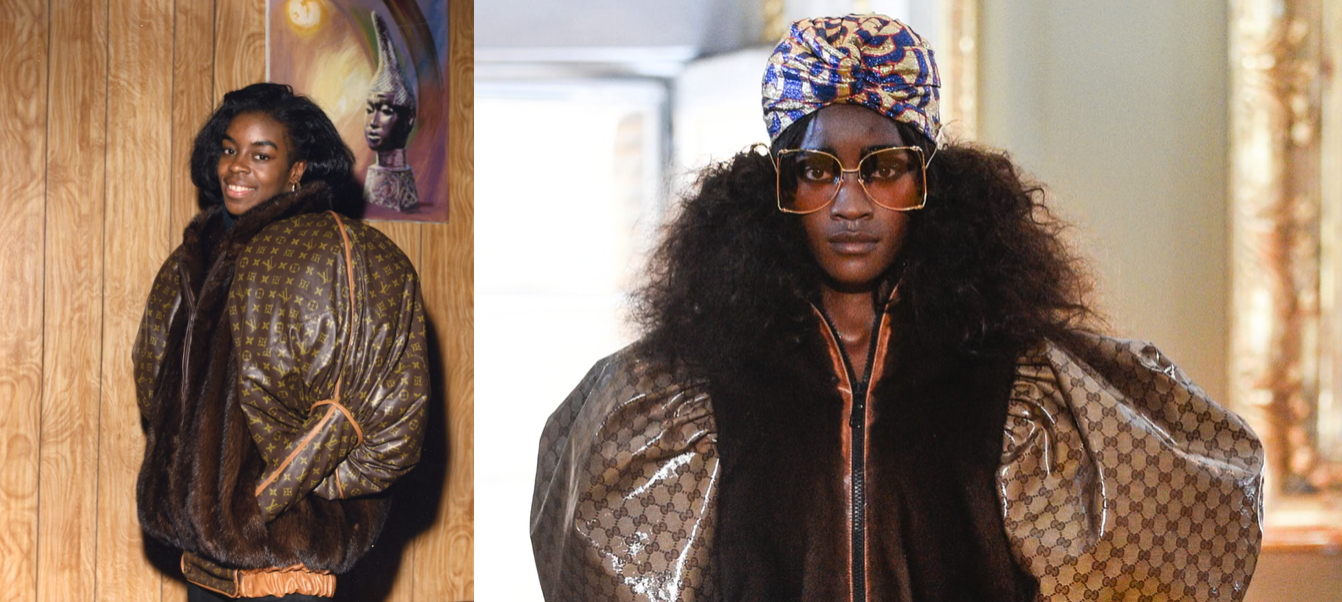
Dan’s original design and the Gucci ‘homage’
Just like all great stories, Dan’s has a twist. In 2017 at a Gucci show in Florence a model walked down the catwalk wearing a mink bomber jacket with puffed up sleeves and a double G monogram. It didn’t take fashionistas long to notice the similarity with one of Dan’s most iconic pieces. Dan’s business had been killed by the high-end labels accusing of him of copyright theft. But now they were stealing from him. Maybe sensing the storm coming their way, Gucci hired Dan to create a capsule collection before funding an atelier for him in Harlem.
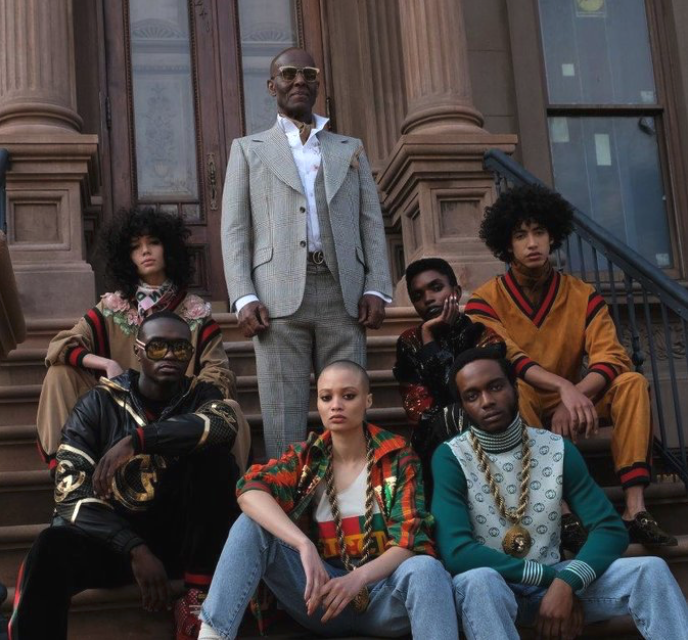
Dan and models posing in Harlem for a photo shoot showcasing his designs for the 2018 collaboration with Gucci
Throughout it all Dan, now into his 80’s, has remained as stylish as ever. As he put it recently, ‘Everybody makes a statement with what they wear, but the dandy makes a narrative.’ And Daniel R. Day most certainly has.