The Magic of Roundabouts
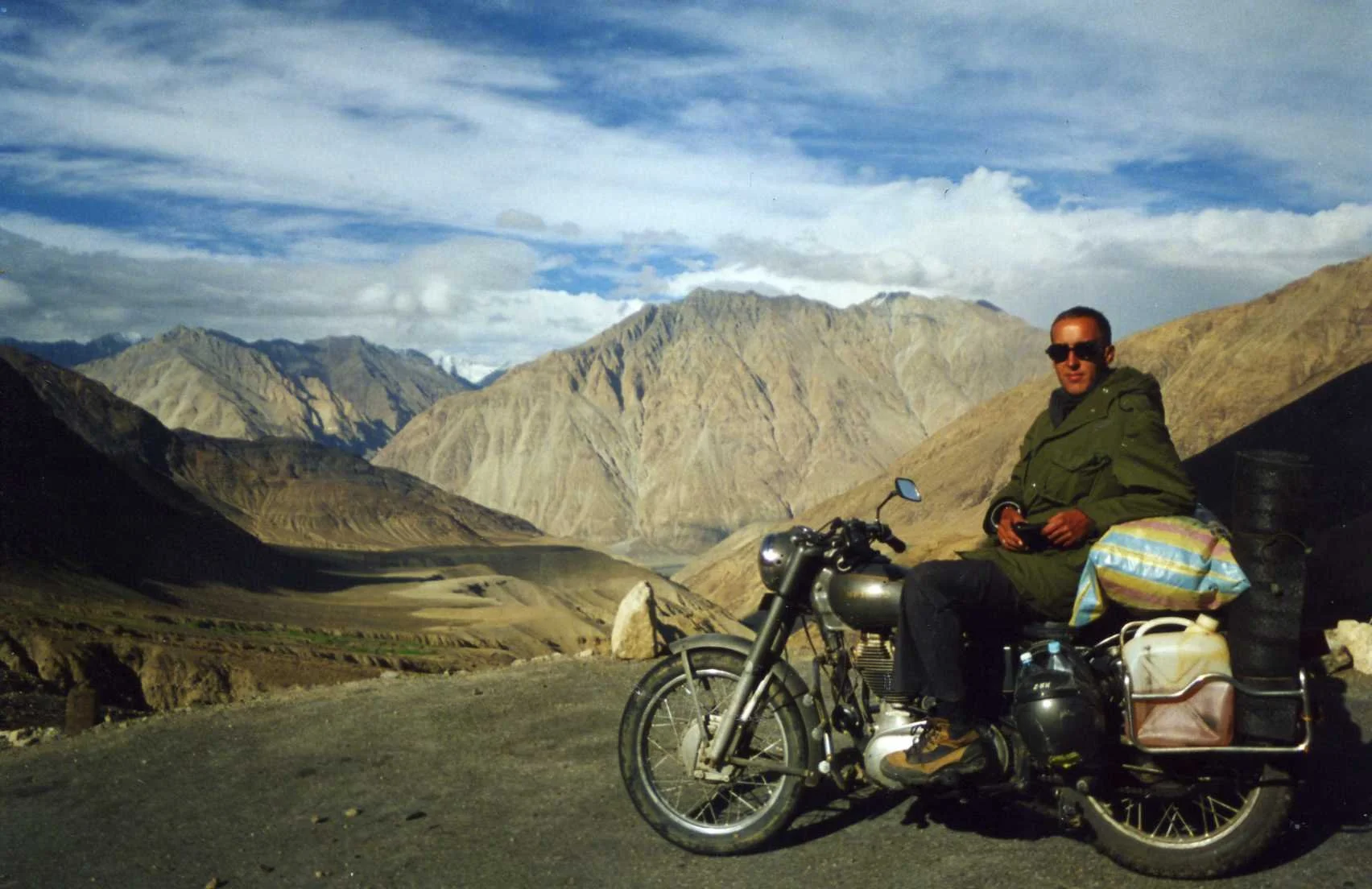
As a 27 year old, carefree and reckless in Ladakh. The last time I looked vaguely cool.
I’ve had some hairy driving experiences over the years: rumbling along vertiginous Himalayan tracks on a motorbike, helmetless; being bamboozled by Arabic signs and driving the wrong way down a dual carriageway in Beirut; wedging a 7.5 tonne lorry in a Welsh lane. But few compare with the heart-in-your mouth madness I encountered in Sicily this summer. Within minutes of picking up the hire car I had a hunch Sicilian driving was going to be unnerving but, even so, the first roundabout was a shock.
Here in buttoned-up old Blighty, traffic approaching a roundabout gives way to the traffic already on it. There’s a sedate, patient queue of cars, all waiting their turn to join, circle round and find their exit. In Sicily: chaos. So far as I could tell the normal rule was inverted. It appeared that cars approaching the junction had the right of way – I watched drivers careen onto the roundabout without a second glance – but, as I rolled up, perhaps too tentatively, none of the vehicles already on the roundabout gave any indication of stopping. Horns, squealing tires, and elaborate hand gestures ensued (one of the many times in my life when I’ve felt awkwardly and inescapably British).
Back home, this got me thinking. About roundabouts. They’re one of those everyday innovations so deceptively simple that we rarely stop to notice them. Roundabouts ensure a constant, steady, self-regulating flow of traffic; they’re the most efficient way to get cars through a junction. They can’t break down or fail in a power cut; they operate without signals or hardware. They’re safe; one US study found they reduce fatal crashes by 90% compared to junctions with signals. And they’re better for the environment; cars tend to slow down but keep moving, rather than stop, start and idle as they would at traffic lights.
Or at least that’s the case in many places round the world. Just maybe not Sicily: there were big queues up to their ‘rotatorias’; their cars bore the scars of less than successful entries and exits; and there was a hell of a lot of stopping and starting, most of it accompanied by screeching.
So what’s the difference?
Well, it’s all down to one man, an eccentric, Algerian born former British pilot and war hero called Frank Blackmore. Roundabouts predated Frank. Famous examples like the Arc De Triomphe in Paris and Columbus Circle in New York existed long before he did. But before Frank all roundabouts worked on the Sicilian principle – traffic on the roundabout gave way to traffic entering. And so they didn’t work any better than a regular kind of junction would have. In fact, they were worse. It didn’t take much traffic for them to become gridlocked.
When he left the Air Force Frank got a job at the Transport Research Laboratory and quickly became obsessed with junctions. On family holidays his wife Eva and three kids got used to him leaping out of the car to take pictures of unusual examples. He even came up with a way of photographing large intersections by pointing a camera up towards a parabola suspended from a crane.
Frank felt instinctively that roundabouts could work better. He just didn’t know how. And then one day it came to him. What if the priority rule was flipped, so that traffic entering gave way to traffic already circulating? It was a beautifully simple solution that didn’t require any engineering. Just education – there are stories of Frank and his team standing with loud hailers instructing drivers on the change in the rules.
At a stroke Frank had taken a long standing problem that was both inefficient and dangerous, and flipped it into an effortlessly elegant solution to traffic flow that most of us benefit from, but few of us notice, every day that we drive.
And Frank’s ingenuity illustrates an important truth about innovation – when faced with a ubiquitous, long-term problem it’s easy to fall into the trap of either accepting it as ‘just the way things are’, or assuming that you need to radically overhaul or re-engineer the system. But often there’s a much simpler reframe, albeit a counterintuitive one.
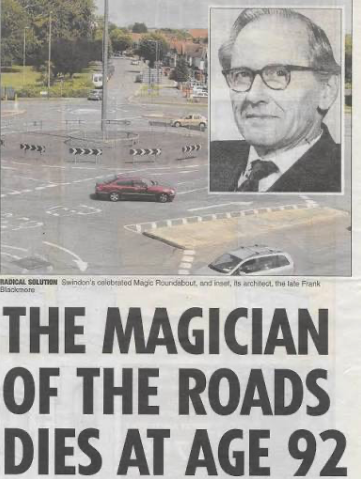
A tribute to Frank on his death in 2008.
Maybe if Frank had worked for the Transport Research Laboratory all his life he wouldn’t have been able to discover this outside the box solution. Perhaps it took the skills and perspective he’d developed as a decorated pilot, used to making the best of what he had during the war, for him to be able to think differently about the challenge. We can’t be sure, but what we do know is that he was able to see the problem in a way no one else could.
After Frank’s priority rule change was introduced to the UK in 1966, most other countries around the world followed suit. Frank, now on a roll, went on to introduce mini roundabouts across the UK before designing his magnum opus, the infamous ‘magic roundabout’ in Swindon: five mini-roundabouts arranged in a circle around a central island; traffic on the outer ring moves clockwise, while the inner island flows counter-clockwise. This, I must confess, does look a little daunting.
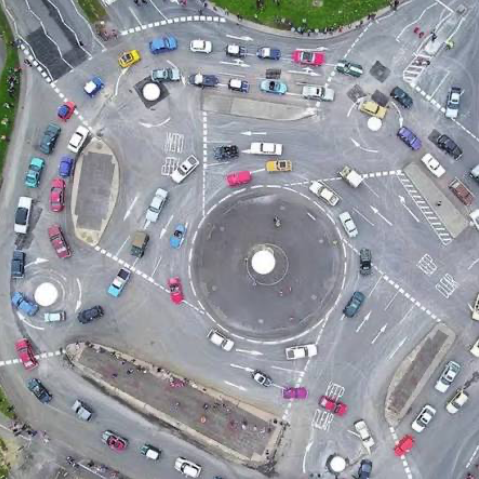
The ‘Magic Roundabout’ in Swindon
Oh, and I checked: in Italy’s Codice della Strada drivers are instructed to follow Frank’s priority principle. But it seems that in Sicily they like to do things differently, which, when it comes to arancini, granita and cannoli, is a wonderful thing. Roundabouts? Not so much.